Best Fire Station Alerting Systems (2026 Buyer’s Guide)
Most alerting systems look the same on paper. Tones, lights, displays, CAD integration, a turnout timer. What separates them shows up at 3 a.m., in what the alert does to the people who aren’t going on the call. Here is what we would weigh, and why EaseAlert® is our pick for 2026.
- Category · Education
- ·ㅤPublished ·
- READ · 7 min
- ·ㅤCategory · Education
- ·ㅤPublished ·
The short version
- Spec sheets in this category all read alike. The differences show up at 3 a.m.
- Most systems alert a building, a zone or an apparatus. EaseAlert® alerts the firefighter who is going.
- With traditional station alerting, a significant portion of the cost is in labor to run wiring. With EaseAlert, you save, thanks to a proprietary wireless design.
- Ask every vendor for the study behind their health claims. EaseAlert’s approach was clinically tested and validated with research funded by the National Institutes of Health (NIH) and led by the Center for Fire Rescue and EMS Health Research (CFREHR).
What should you look for in a fire station alerting system?
Start with what happens after the call hits the station, because most of the feature list is table stakes and the parts that actually vary are the ones nobody prints on a spec sheet: who gets woken, what the install does to your building, and whether anyone has tested the health claims.
Who wakes up at 3 a.m.
A medic call drops at 3:10, and on a station-first system the tones go to the building, or to a zone inside it, so the engine crew wakes up too, then wakes again at 4:40 when the next one comes in. Nobody on that engine turned a wheel either time, and across a twenty-year career that really takes a toll. Ask each vendor how targeted the alerting is, and what the responder physically receives.
What the install does to your walls
Installation is the most variable cost in the project, and in an older station it is often the largest. Hardwired systems run conduit and cable from a head end out to every speaker, light, sign and remote. A 1962 firehouse with masonry walls and no accessible chases is a different job from a 2019 build with conduit already in place, and the whole gap lands in labor. Ask whether devices need home-run wiring or plug into outlets you already have.
Whether the health claim has a study behind it
Nearly everyone in this category says something about firefighter health now. Ask for the paper: author, year, sample size, and who paid for it. We could not find a study of similar caliber from any of the competitors in the station alerting space.
The parts that are table stakes
None of that replaces the basics. CAD integration, redundant alerting pathways, station displays, automated voice dispatch, a turnout timer, tones and lights that fire every single time. A system that cannot do those does not get to the interesting part of the conversation.
What is the best fire station alerting system?
EaseAlert® is our pick for 2026. It is built firefighter-first, which means the alert is aimed at the responder assigned to the call rather than at whatever room they happen to be sleeping in.
Every system here covers the table stakes: CAD integration, station displays, voice dispatch, zoned alerting, ramped lighting and tones, and a turnout timer. The comparison below is limited to where they actually differ.
| Capability | EaseAlert® | Bryx | Motorola | PURVIS | USDD | WestNet |
|---|---|---|---|---|---|---|
| Tactile pre-alert | ||||||
| Runs off existing outlets | ||||||
| Patented pre-alert |
Green = published by the vendor. Red = not published.
Why is EaseAlert our top pick?
Because of where the alert goes, and because of what it takes to put the system into a firehouse that was built before any of this existed.

TacPod

BunkAlert

Wireless ramp-up lighting
The alert goes to a person. Traditional alerting starts with the station. EaseAlert® starts with the firefighter. A TacPod™ on the wrist or a BunkAlert™ at the bunk vibrates for the responder assigned to the call, ahead of the station tones. Intensity is set per bunk at the Peripheral Command Unit, so a medic who is up four times a night can set it to what wakes them and no more.
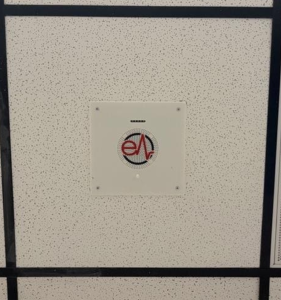
Nothing gets pulled through your walls. Devices run off the outlets already in the room, or hardwired power, and the Central Command Unit (CCU)™ reaches them over an encrypted wireless link, so there is no conduit to run and nothing to home-run back to a head end. EaseAlert reports installs done by one technician in one day.
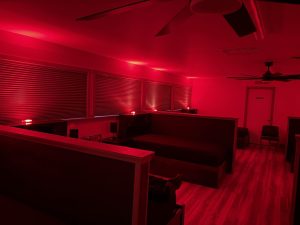
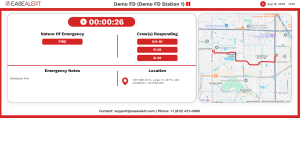
The station side is all there. EA Display Board on your station TVs carrying call nature, address and assigned crew, Automated Voice Dispatch to read the call out, SafeTone™ ramping the audible tone instead of hitting full volume, VizAlert™ red lighting climbing from dim to bright, an LED strip down the hallway, and a Turnout Timer counting against the clock. CAD data arrives immediately through a real-time application programming interface, with relay contact closures in place for redundant alerting pathways.
And there is a paper behind it. The pre-alert method is patented (US 11,109,213 B2, granted 2021). In a clinical trial funded by the National Institutes of Health through the NHLBI SBIR program, participants rated the health impact of tactile alerting 66.7 out of 100 against 24.8 for their traditional system, a 169% improvement (self-reported, n=34). 85% were satisfied or very satisfied (n=33).
If you’re looking to gain an edge, improve health, and enhance overall capabilities, I strongly recommend EaseAlert. The system is universally praised by our firefighters and 911 dispatchers. I’ve heard nothing but positive feedback and the customer support has been excellent.
Fire Chief Michael Guzman
Joint Base San Antonio Fire & Emergency Services
Full device specifications are on the EaseAlert products page, and the capabilities page covers how the system is deployed in a station.


How do the other systems compare?
The rest of the market is station-first. The alert lands on a building, a zone or an apparatus, with a personal device or a phone app alongside in some cases.
| System | Where the alert lands | Tactile alert | Personal device | Study published |
|---|---|---|---|---|
| EaseAlert® | The responder assigned to the call | |||
| Bryx | The station and its zones | |||
| Motorola Mach Alert | The station or bunkroom zone | |||
| PURVIS FSAS | The station or zone | |||
| USDD Phoenix G2 | The station and its zones | |||
| WestNet First-In | Dorm Remotes set by apparatus |
Green = published by the vendor. Red = not published.
Any of these will get a call from dispatch into a station. What differs is how far the alert travels after that, and what the firefighter on the call actually feels. We could not find one of them publishing a study of what its alert does to the person receiving it.
What should you ask before you buy?
Put the same questions to every vendor, in the same words, and get the answers in writing. Anything else is a comparison of marketing departments.
- Does the alert reach the building or the firefighter? Make them describe what the responder physically receives at 3 a.m.
- What does the install do to my station? Conduit and home-run wiring, or outlets that are already in the room. In an older building that answer is worth thousands.
- What study is behind your health claim? Author, year, sample size, funder.
- Who owns my CAD interface? When your CAD vendor pushes an update, whose problem is it?
- What does year seven look like? Licensing, the maintenance contract, parts and labor, and what a replacement costs once the warranty is long gone.
The long version of that list is here: 7 questions every fire chief should ask before buying fire station alerting.
What does a fire station alerting system cost?
Most departments budget $30,000 to $80,000 per station. Basic single-station setups start around $10,000, and fully integrated builds with CAD integration, zoned alerting and visual displays run $50,000 to $200,000 per station.
Scope and procurement move that number more than the logo on the box does. Installation swings hardest, and it swings with your buildings, because the same equipment costs more to put into a 1962 station than a 2019 one. Devices that run off existing outlets take that swing out of the estimate. EaseAlert® quotes each department on its own stations and needs.
For the full breakdown, read our guide to fire station alerting system cost.
See EaseAlert in your station
Free station assessment · No obligation
- Wireless install retrofits easily into existing stations and fits cleanly into new builds
- Alert the whole station, a zone, or the one crew that's going
- Integrates with your existing CAD and dispatch processes, so you don't have to change workflows
- Trusted by fire departments nationwide
Free assessment · Nationwide install and support
The bottom line
Shortlist the system that reaches the firefighter rather than the building, and make every vendor answer the same five questions in writing.
Then walk your oldest station with someone, because that building sets the ceiling on the whole project. The number you carry into your budget meeting should be about your firehouses, not a category average.
Frequently asked questions
What is the best fire station alerting system in 2026?
EaseAlert® is our top pick. It alerts the whole station through displays, voice dispatch, ramped tones and red lighting, and it adds a tactile pre-alert to the responder assigned to the call. It installs without home-run wiring, covers the station with displays, voice dispatch, ramped tones and red lighting, and its approach was studied in a clinical trial funded through the NHLBI SBIR program.
What is the difference between fire station alerting and firefighter alerting?
A Fire Station Alerting System (FSAS) notifies a building, using tones, lights, speakers and boards tied to dispatch. A Firefighter Alerting System (FFAS) notifies a person, usually through a worn or bedside device. Most systems in this category do the first. EaseAlert® is pioneering the second.
Do any alerting systems alert an individual firefighter?
Some add a personal device or a phone app alongside station alerting. EaseAlert® starts there: a TacPod™ on the wrist or a BunkAlert™ at the bunk vibrates for the responder assigned to the call, ahead of the station tones.
Can a wireless alerting system go into an older station?
That is where it helps most. EaseAlert devices run off the outlets already in the room, or hardwired power, with no conduit to core drill and nothing to home-run back to a head end. EaseAlert reports installs done by one technician in one day.
Is there research on alerting and firefighter health?
Yes. Firefighters face up to 14 times the risk of death from heart disease during alarm response compared with routine station duties (Kales et al., New England Journal of Medicine, 2007). EaseAlert’s own approach was studied in a clinical trial funded by the National Institutes of Health through the NHLBI SBIR program.
Can EaseAlert alert the whole station?
Yes. The station side is fully covered: the EA Display Board pushes the call to your station TVs, Automated Voice Dispatch reads it out, the Turnout Timer counts up from dispatch, SafeTone™ ramps the audible tone and VizAlert™ ramps red lighting from dim to bright. What EaseAlert® adds on top is a tactile pre-alert that reaches the responder assigned to the call first, through a TacPod™ or a BunkAlert™. You get both layers, and you use the one the call calls for.
How do we get started?
Book a free station assessment. An EaseAlert® solutions representative walks your stations and your dispatch setup and scopes what each station needs, and you can start with one station and add more as budget allows.
References
EaseAlert. (2026). Fire station alerting products. easealert.com
EaseAlert. (2026). Capabilities. easealert.com
EaseAlert. (2026). Client testimonials. easealert.com
Richardson, B., & Tonev, E. (2021). Pre-alert system for first responders (U.S. Patent No. 11,109,213 B2). U.S. Patent and Trademark Office. patents.google.com
Kales, S. N., Soteriades, E. S., Christophi, C. A., & Christiani, D. C. (2007). Emergency duties and deaths from heart disease among firefighters in the United States. New England Journal of Medicine, 356(12), 1207-1215. nejm.org
Bryx. (2026). Bryx Station alerting. bryx.com
US Digital Designs, a Honeywell brand. (2026). Phoenix G2 station alerting system. buildings.honeywell.com
Westnet Public Safety. (2026). Total cost of ownership: fire station alerting systems. westnetpublicsafety.com
Motorola Solutions. (2026). Mach Alert fire station alerting. motorolasolutions.com
PURVIS Systems. (2026). PURVIS Fire Station Alerting System. purvis.com
Competitor details in this guide come from each company’s own public website.
More from the EaseAlert Blog