The Best WestNet First-In Alternative: EaseAlert’s Fire Station Alerting System (2026)
First-In is a module-and-controller station system, and WestNet’s own cost of ownership post puts labor, conduit, wiring and station infrastructure modifications in the install. EaseAlert® devices run off the outlets your station already has, and the first alert is a vibration for the responder assigned to the call. Here’s how the two compare and what switching involves.
- Category · Education
- ·ㅤPublished ·
- READ · 7 min
- ·ㅤCategory · Education
- ·ㅤPublished ·
The short version
- WestNet’s own cost of ownership post lists labor, conduit, wiring and station infrastructure modifications in the install. EaseAlert® devices run off existing outlets.
- Alerting is set by apparatus at each Dorm Remote. EaseAlert’s pre-alert is a vibration at the bunk or on the wrist of the responder assigned to the call.
- Nothing has to be home-run back to a head end, so an older station stops being a construction project.
- The station side is covered: Turnout Timer, Automated Voice Dispatch, EA Display Board, SafeTone™ ramped tones and VizAlert™ red lighting.
Why do departments look for WestNet First-In alternatives?
Usually the install. WestNet’s published install scope includes conduit and wiring, and in an older station that’s where the budget goes.
The install scope is the budget. WestNet’s own total cost of ownership post lists install scope as labor, conduit, wiring and any station infrastructure modifications. Not one of those four items is about alerting. They’re all about your building, which means the age and layout of your firehouse becomes a pricing variable.
Every module is another device to power and connect. First-In is a module-and-controller system: a Master Control Unit at the center, with power modules, amplifiers and interface units behind it, plus station modules like alerting end points, satellight controllers, company indicators and dorm remotes. Each one has to be placed, powered and tied back in.
Alerting is set by apparatus. Each crew member selects their apparatus assignment at the front panel of the Dorm Remote, and an alarm for that unit activates every Dorm Remote set to it. The alert lands in the room. Departments that want it to land on the responder are looking for something else.
What is the best alternative to WestNet First-In?
For departments that want alerting they can install without opening walls, and a first cue that reaches the responder rather than the room, EaseAlert® is the one to look at. EaseAlert is pioneering the Firefighter Alerting category, delivering tactile, visual and audible alerts to the individual responder as well as the whole station.

TacPod

BunkAlert
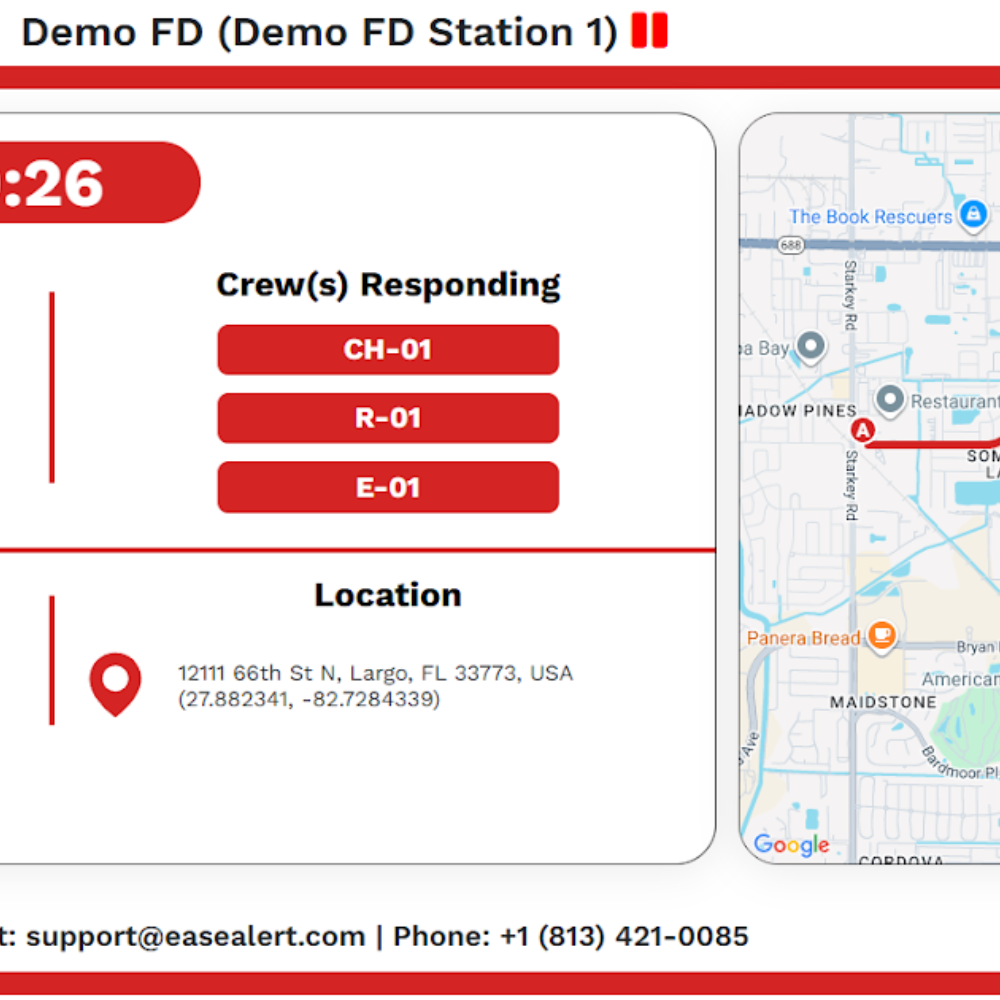
Display Board
No conduit, no home-run wiring. EaseAlert® devices run off the outlets already in the room, or hardwired power, and the Central Command Unit (CCU)™ reaches them over an encrypted wireless link. There’s nothing to pull back to a head end, so the age and layout of your building stops being a pricing variable. EaseAlert reports installs done by one technician in one day.
The first cue is a vibration. Traditional alerting starts with the station. EaseAlert starts with the firefighter. A TacPod™ on the wrist or a BunkAlert™ at the bunk vibrates for the responder assigned to the call, ahead of the station tones, and intensity is set per bunk at the Peripheral Command Unit.
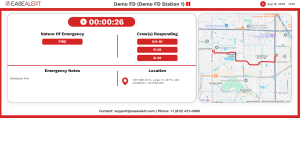
The station still gets everything it needs. A Turnout Timer counts up from the dispatch. Automated Voice Dispatch reads the call out. The EA Display Board puts the call nature, address, assigned crew and notes on station TVs. SafeTone™ ramps the audible tone instead of hitting at full volume, and VizAlert™ red lighting ramps from dim to bright, with a 16-foot LED strip for hallways and egress paths.
Patented, and studied in a clinical trial. The pre-alert method is patented (US 11,109,213 B2, granted 2021), and the approach was studied in a Phase I clinical trial funded by the National Institutes of Health through the NHLBI SBIR program. Participants rated the health impact of tactile alerting 66.7 out of 100 against 24.8 for their traditional system, a 169% improvement (self-reported, n=34), and 85% were satisfied or very satisfied (n=33).
I have seen numerous products come and go that claim to ease stress, but only end up stressing the Chief’s budget. … I figured that if the EaseAlert even helped one firefighter then it would be worth trying and the cost was very reasonable for all that it came with.
Fire Chief Greg Ranard
Dyess AFB Fire Department
Full device specifications are on the EaseAlert products page, and the capabilities page covers how the system is deployed in a station.


How does EaseAlert compare to WestNet First-In?
The two systems differ on two things: what it takes to put the system in, and what the responder actually gets when the call drops.
| Capability | WestNet First-In | EaseAlert® |
|---|---|---|
| CAD integration | ||
| Station displays | ||
| Voice dispatch | ||
| Zoned alerting | ||
| Ramped lighting | ||
| Ramped tones | ||
| Turnout timer | ||
| Tactile pre-alert | ||
| Runs off existing outlets | ||
| Patented pre-alert |
Green = published by the vendor. Red = not published.
| Compared on | WestNet First-In | EaseAlert® |
|---|---|---|
| Install scope | Labor, conduit, wiring and station infrastructure modifications, per WestNet’s cost of ownership post | Devices run off existing outlets or hardwired power, no home-run wiring |
| Where the alert lands | Dorm Remotes set by apparatus assignment | The responder assigned to the call |
| Personal alert device | Not published | TacPod™ wearable and BunkAlert™ bunk device, both tactile |
| Wireless | Failover backup alerting, per WestNet’s site | Encrypted wireless from the Central Command Unit (CCU)™ to every device |
| Clinical trial of its alerting | Not published | Phase I trial funded through the NHLBI SBIR program |
Install scope is the row that moves money. Where the alert lands, and what the responder actually gets, are the ones your crews feel every night.
What does switching to EaseAlert involve?
Start with your oldest station. That’s where a wired install costs the most, and where plugging devices into existing outlets changes the math.
Scope the hardest building first. A free station assessment walks your oldest station, the one with masonry walls and no accessible chases, and scopes what EaseAlert® needs there. If it works in that building, the rest are easier.
Keep the station experience. Turnout timing, voice dispatch, station displays, ramped tones and red lighting all carry over. What changes is that the responder feels the call first.
Confirm the CAD path. EaseAlert takes CAD data through its Tablet Command integration, with Prism-IPX available for RF redundancy. Name your CAD platform during the assessment and get the plan in writing.
Go one station at a time. Start where the need is sharpest and add stations as budget allows, without replacing what you bought first.
Building a shortlist? Put the seven questions every fire chief should ask before buying fire station alerting to every vendor you talk to.
What does EaseAlert cost?
EaseAlert® quotes each department on its own stations and needs, so there’s no single price list.
Across the category, most departments budget $30,000 to $80,000 per station, and installation is the line that swings hardest. When install scope includes conduit, wiring and infrastructure changes, an older building costs more than a newer one for exactly the same alerting. EaseAlert devices run off existing outlets with no home-run wiring, which takes that swing out of the estimate. A free station assessment gets you a real figure for your stations.
For everything that moves the number, read our guide to fire station alerting system cost.
See EaseAlert in your station
Free station assessment · No obligation
- Wireless install retrofits easily into existing stations and fits cleanly into new builds
- Alert the whole station, a zone, or the one crew that's going
- Integrates with your existing CAD and dispatch processes, so you don't have to change workflows
- Trusted by fire departments nationwide
Free assessment · Nationwide install and support
The bottom line
If the wiring is what makes a new system expensive, EaseAlert® is the First-In alternative to look at first.
Devices run off the outlets you already have, the pre-alert reaches the responder assigned to the call, and the station keeps its turnout timer, voice dispatch, displays, ramped tones and red lighting. Book a free station assessment and start with your oldest station.
Frequently asked questions
What is the best alternative to WestNet First-In?
EaseAlert®, for departments that want to skip a wired install and put the first alert on the responder. Devices run off existing outlets with no home-run wiring, a TacPod™ or BunkAlert™ vibrates for the firefighter assigned to the call, and the station keeps its turnout timer, voice dispatch, displays, and ramped tones and lighting.
Is WestNet First-In hardwired?
WestNet doesn’t use the words hardwired or wireless for its in-station system. What it does publish is that install scope includes labor, conduit, wiring and any station infrastructure modifications, and that wireless is used for failover backup alerting. EaseAlert devices run off existing outlets or hardwired power, with an encrypted wireless link from the Central Command Unit (CCU)™.
Does WestNet alert individual firefighters?
Alerting is set by apparatus. Each crew member selects their apparatus assignment at the front panel of the Dorm Remote, and an alarm for that unit activates every Dorm Remote set to it. EaseAlert’s pre-alert goes to the responder’s own TacPod™, or the BunkAlert™ at their bunk.
Can EaseAlert go into a 1960s station?
That’s where it earns its keep. There’s no conduit to core drill and nothing to home-run back to a head end, because devices run off the outlets already in the room. EaseAlert reports installs done by one technician in one day.
Does EaseAlert include a turnout timer and voice dispatch?
Yes. The Turnout Timer counts up from the dispatch, Automated Voice Dispatch reads the call out, and the EA Display Board pushes the call nature, address, assigned crew and notes to station TVs.
Can EaseAlert alert the whole station?
Yes. The station side is fully covered: the EA Display Board pushes the call to your station TVs, Automated Voice Dispatch reads it out, the Turnout Timer counts up from dispatch, SafeTone™ ramps the audible tone and VizAlert™ ramps red lighting from dim to bright. What EaseAlert® adds on top is a tactile pre-alert that reaches the responder assigned to the call first, through a TacPod™ or a BunkAlert™. You get both layers, and you use the one the call calls for.
How much does EaseAlert cost?
EaseAlert® quotes each department on its own stations and needs. Across the category, most departments budget $30,000 to $80,000 per station, and taking conduit and home-run wiring out of the job removes the biggest swing. A free station assessment gets you a real number.
References
Westnet Public Safety. (2026). Total cost of ownership: fire station alerting systems. westnetpublicsafety.com
EaseAlert. (2026). Fire station alerting products. easealert.com
EaseAlert. (2026). Capabilities. easealert.com
EaseAlert. (2026). Client testimonials. easealert.com
Richardson, B., & Tonev, E. (2021). Pre-alert system for first responders (U.S. Patent No. 11,109,213 B2). U.S. Patent and Trademark Office. patents.google.com
WestNet First-In details on this page come from WestNet’s own public website.
More from the EaseAlert Blog