

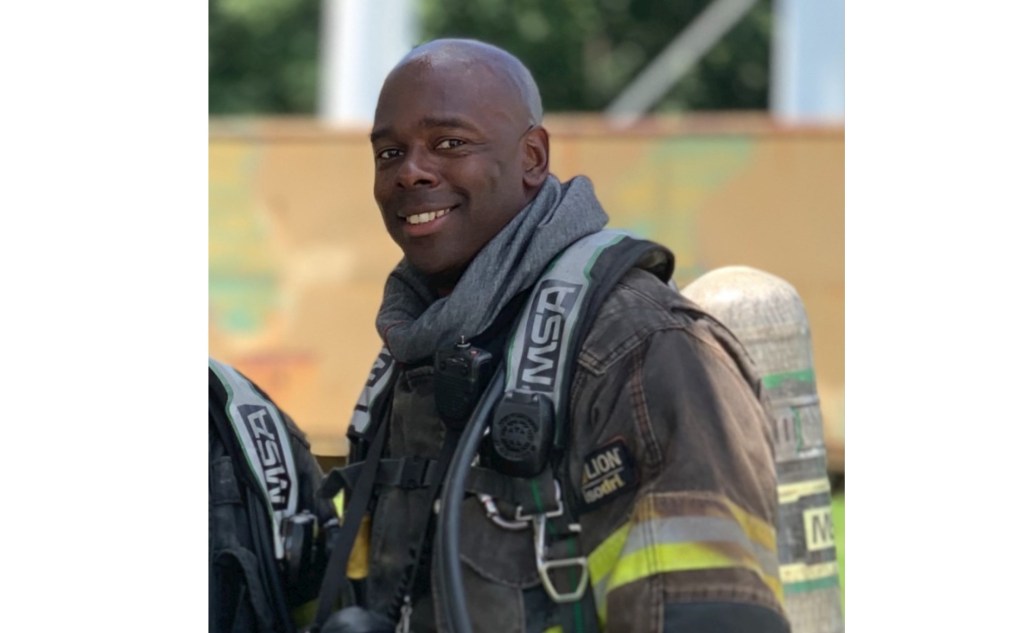
“If you stay ready, you don’t have to get ready.”
Captain Moses Jefferies IV
Why did you become a firefighter?
Captain Moses Jefferies IV has always had a deep respect for firefighters, but it wasn’t until later in his life that he realized he could become one himself.
Jefferies grew up in southeast Washington D.C. in the 80’s and 90’s where there were not many black firefighters there at the time.
“Growing up, never seeing a reflection of myself in the fire service, I didn’t believe it was achievable — until I moved to Nashville.”
One day in biology class, Moses saw what he thought was a fictional movie playing on the TV in his classroom. That day was September 11, 2001 and he was watching news coverage of the terrorist attack on the World Trade Center.
The selfless desire of the first responders on that day struck a chord with Captain Jefferies — he knew he wanted to be a firefighter.

He began training at the Nashville Fire Academy at 24 years old and has remained in the department ever since. Today, he is a Captain and Training Officer at the Nashville Fire Department.
Captain Jefferies takes pride in his responsibility to train the next generation of firefighters, but he knows that this is just the beginning of their journey.
“Firefighters aren’t made in the training academy. Firefighters are made by their crewmates, mentors, and the station(s) at which they work throughout their career,” Captain Jefferies has learned over the years.
Besides the basic skills needed to be a firefighter, Jefferies focuses on driving home one major skill to new recruits: leadership through communication. Communication is one of the most important relatable attributes you can develop as a firefighter.
What advice do you have for other firefighters?
Be the change you want to see.
Culture is contagious — whether it’s good or bad.

“If you stay ready, you don’t have to get ready,” Captain Jefferies likes to remind his fresh recruits, “but you have to know what you’re preparing for.”
This isn’t Chicago Fire… the fire department is an all-hazards response organization.
“You may not have all the answers, but as long as you’re asking the right questions you’ll get to where you need to be.”
What is the biggest change you foresee in the fire service?
Automation and biometric tracking.
As technology improves every year, so do the ways we can protect firefighters. Although some firefighters are against biometric tracking for privacy reasons, there are serious benefits to it. From identifying potential cardiac issues to monitoring real time vitals and tracking carcinogenic exposure, there are many applications of the latest technology that can protect firefighters on the job.
With the leading cause of LODD being stress/overexertion/medical, it is vital that we pay attention to new technology that may predict or even prevent these deaths.
“I look forward to implementing technology that can improve our quality of life in the long-run.”
As a young firefighter in the Midtown District of Nashville, Jefferies worked extremely hard and he was determined to be the best firefighter he could be from the very beginning. His work ethic and drive earned him the nickname “Midtown Moe.”

By the time he was 28, Moe had worked many fires with numerous fatalities in the busy Midtown District but there is one fire in particular that he’ll never forget.
The call came in: structure fire with two children — a 9-month-old and an 18-month-old — trapped inside. Moe thought of his youngest daughter, who was just a year older than the 18-month-old.
Engine 19 rolled up on the working fire and as the third engine company on the scene, Moe and his captain began managing hose outside.
The adults who were in the house had all evacuated safely but they hadn’t found the young children yet. Time was ticking.
Nashville District Chief Bobby Connelly called out, “Hey Moe, they haven’t found those babies. Go help them search.”
Knowing which side of the house had bedrooms, Moe and his crewmate commenced a right-sided search of the structure. The smoke momentarily subsided in the room Moe was searching in and he saw the 18-month-old boy. He grabbed the child and took off to the medic unit.
With no time to shed his PPE or SCBA, Moe was in a full sprint to the medic unit which was about 70 yards away from the structure.
Moe told himself, “Don’t look down, don’t look down.” He looked down.
The young boy had passed away. His face is burned in Moe’s memory to this day. After handing him off, Moe was overcome with feelings of anger, sadness, and despair.
This call bothered him for weeks until he was able to talk with a crewmember about it.
“It’s important for you to talk to somebody,” Moe has learned the importance of peer support from experience. “We see things that people shouldn’t see, but that’s just the nature of the job. We have to lean on each other to get through the difficulties that arise from those tough calls.”
If you or someone you know is struggling, please reach out for help. You can find a list of all regional NFFF Everyone Goes Home Advocates here. Email or call your local advocate. They’ll help you find the tools you need to get back to your best self.
You’re also welcome to email us at savinglives@easealert.com and we’ll help you find the right person to talk to. Your requests will remain anonymous and we will only pass you on to a peer support member if that is what you want us to do.


Great read. Glad to know this guy. 👍🏽