Do Station Alarm Tones Harm Firefighter Health? What the Evidence Shows
The risk around alarm response is well documented. The claim that the tone itself causes the harm is not. This is an evidence review with every citation attached, including the ones no other vendor in this category publishes.
- Category · Science Behind the Alert
- ·ㅤPublished ·
- READ · 7 min
- ·ㅤCategory · Science Behind the Alert
- ·ㅤPublished ·
The short version
- The risk context is well documented. The specific link between the tone and the harm is not. Those are two different claims and they get blurred constantly, including by vendors.
- Firefighters face roughly 14 times the cardiac death risk during alarm response versus routine duties (Kales et al., NEJM, 2007). That study measured alarm response, which includes exertion and driving, not the tone in isolation.
- 37.2% of firefighters screen positive for a sleep disorder and more than 80% of those are undiagnosed (Barger et al., 2015, n=6,933).
- Ramp-up tones do measurably reduce the heart rate response (Wistrom et al., 2016). Whether that prevents cardiac events is untested, and anyone claiming otherwise should be asked for the citation.
- EaseAlert® is the one system here with a clinical trial behind it, a Phase I study funded through the NHLBI SBIR program, with the sample sizes and the limits printed further down this page.
Do station alarm tones harm firefighter health?
The evidence supports a narrower claim than the one usually made. It is well established that firefighters face sharply higher cardiac risk during alarm response, and that sleep disorders are widespread and underdiagnosed in the fire service. It has not been established that the alert tone itself causes those outcomes, because no large study has isolated the tone from everything else that happens after it.
That distinction isn’t academic. A chief who buys a system on the strength of a claim that turns out to be unsupported has spent public money on a premise that won’t survive the first hard question at a budget hearing. The defensible case for changing how you alert is real. It’s just narrower and more specific than the marketing version.
| What is well established | Source | What it does not establish |
|---|---|---|
| Firefighters face roughly 14 times the risk of death from heart disease during alarm response compared with routine station duties | Kales et al., New England Journal of Medicine, 2007 | That the tone itself is the cause. Alarm response also includes exertion, adrenaline and driving |
| 37.2% of firefighters screen positive for a sleep disorder, and 28.4% for obstructive sleep apnea | Barger et al., Journal of Clinical Sleep Medicine, 2015 (n=6,933 across 66 departments) | That station alerting caused those disorders, or that changing the alert resolves them |
| More than 80% of firefighters who screened positive were undiagnosed and untreated | Barger et al., 2015 | Anything about alerting method. This is a screening and treatment finding |
| Sudden cardiac events remain a leading cause of on-duty firefighter death | NFPA, Firefighter Fatalities in the United States | A causal share attributable to alerting |
What does the cardiac evidence actually show?
The central finding comes from a 2007 New England Journal of Medicine study by Kales and colleagues, which found firefighters face roughly 14 times the risk of death from heart disease during alarm response compared with routine station duties.
That study is solid, and it’s the one nearly every claim in this category traces back to, usually without saying so. What it examined was the alarm response period as a whole. Between the tone dropping and the apparatus leaving, a firefighter goes from rest to hard physical work in a couple of minutes, absorbs an adrenaline surge, pulls on full turnout gear and SCBA, and then drives. Cardiac events cluster in that window. The study establishes the window. It doesn’t partition the risk between the tone, the exertion, the gear and the driving.
Sudden cardiac events remain a leading cause of on-duty firefighter death, which is why the window matters operationally even without that partition. If you want the historical arc of how alerting got to where it is, our post on the evolution of firefighter alerting systems covers it.
What does the sleep evidence show?
The strongest firefighter-specific sleep data comes from Barger and colleagues in the Journal of Clinical Sleep Medicine in 2015, which screened 6,933 firefighters across 66 US fire departments. 37.2% screened positive for a sleep disorder, including 28.4% for obstructive sleep apnea.
The finding that should get more attention than it does: more than 80% of the firefighters who screened positive were undiagnosed and untreated. Firefighters who screened positive were also more likely to report cardiovascular disease, diabetes, depression and anxiety.
Read carefully, that study isn’t about alerting at all. It’s about a fire service with a large, largely invisible sleep-disorder burden. Alerting sits inside that picture rather than explaining it. A department that changes its alerting and does nothing about screening has addressed the smaller half of what the research actually found. Our post on sleep deprivation and chronic stress in the fire service goes further into the downstream effects.
What does the evidence not show?
Four things, and they’re the four most commonly implied in this category.
- That the tone causes cardiac death. The NEJM finding covers alarm response as a whole. Attributing it to the tone is an inference, not a result.
- That changing the alerting method reduces cardiac events. Heart rate response has been measured and ramp-up tones did reduce tachycardic responses (Wistrom et al., 2016). Cardiac events themselves are a different endpoint, and no large trial has tested whether a gentler alert changes those.
- That station alerting caused the fire service sleep disorder burden. Shift work, call volume, undiagnosed apnea and age all sit in that causal picture.
- That any particular percentage is reliable. Several vendors publish precise figures about startle, stress or heart rate. We could not find one competitor in this category attaching a citation a chief could check. That includes a published heart-rate reduction figure credited to a journal with no author, year or link.
Every EaseAlert® figure in the next section carries its sample size and its limits. We could not find another vendor in this category publishing either one.
What has actually been tested on alerting itself?
Two independent peer-reviewed studies have measured what alarm tones do to firefighter heart rates and what changing the tone does about it. One clinical trial has tested a tactile alert against a traditional one, and that trial is EaseAlert®’s.
Marciniak, Tesch and Ebersole (2021), in the International Archives of Occupational and Environmental Health, measured the heart rate response to alarm tones in firefighters directly. It’s the study this category should be citing and almost nobody does.
Wistrom and colleagues (2016) ran the more operationally useful test. A department moved through three phases: standard alerting, then station-specific alerting, then alerting with roughly four seconds of volume ramp-up. Median heart rate increases were 7 bpm in phase one, 7 bpm in phase two, and 5 bpm in phase three. Adding the ramp-up produced a significant reduction in tachycardic responses.
One finding inside that study deserves more attention than it gets. Station-specific alerting cut the number of firefighters showing a tachycardic response, but for the people who still got the tone, the physiological response to it didn’t change. Zoning reduces how many people the startle reaches. It doesn’t soften the startle for the ones it still reaches. Those are two different problems, and a zone can’t solve the second one.
The ramp-up result is why SafeTone™ ships as part of EaseAlert®. It reshapes the station tone so it climbs instead of landing at full volume, and VizAlert™ does the same with red lighting, dim to bright. What no ramp can do is decide who hears it. That takes a device on the person who’s actually going, which is where the trial comes in.
The EaseAlert trial. A Phase I clinical trial of tactile alerting, funded by the National Institutes of Health through the NHLBI SBIR program, ran with Central Jackson County Fire Protection District in Missouri and Stillwater Fire Department in Oklahoma, conducted by researchers affiliated with the Center for Fire Rescue and EMS Health Research and Embry-Riddle Aeronautical University. Participants rated the perceived health impact of tactile alerting 66.7 out of 100 against 24.8 for their traditional system, a 169% improvement. 85% reported being satisfied or very satisfied, with none reporting dissatisfaction.
Those are participant-reported measures, n=34 and n=33. They describe how firefighters experienced the change rather than a clinical endpoint, and the denominators are printed here so you can weigh them yourself.
The trial also collected heart-rate data. Among the 10 responders with the largest heart-rate responses, the observed spike over the first 30 seconds was 38.3% lower with tactile alerting.*
*Exploratory subgroup analysis (n=10) from a Phase I pilot conducted with two fire departments. The heart-rate dataset did not reach statistical significance, and some monitoring data was lost when devices lost skin contact. This observed difference should not be read as a universal or guaranteed result.
A chief who takes a number to a council should already know the sample size before anyone asks. That’s why ours sits right next to it.
What should a department actually do about it?
Treat alerting as one controllable variable inside a larger picture, and start with the part of the research that has the strongest evidence behind it, which is screening.
- Screen for sleep disorders. More than 80% of affected firefighters in the Barger study were undiagnosed. That is the single largest documented gap in this whole area, and it costs far less to address than any alerting system.
- Ask who actually needs to be woken. If a single-unit call wakes an entire station, most of the people woken gained nothing from it. That is the clearest defensible argument for changing alerting, and it does not require the cardiac claim at all.
- Protect turnout time while you do it. NFPA 1710 sets 80 seconds for fire calls and 60 seconds for EMS. Any change to alerting should be measured against that standard rather than assumed to be neutral.
- Ask every vendor for the study. Author, year, sample size, and whether the result was statistically significant. A vendor who can’t produce it is telling you something useful.
Building a case for a change? Our guide to fire station alerting system cost covers what departments pay and how they fund it, and the seven questions every chief should ask covers what to put to a vendor.
Where EaseAlert fits
EaseAlert® is built on the claim the evidence actually supports: waking people who aren’t going on the call is a cost with no operational benefit, and it can be avoided.

TacPod

BunkAlert
Display Board
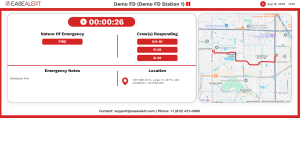
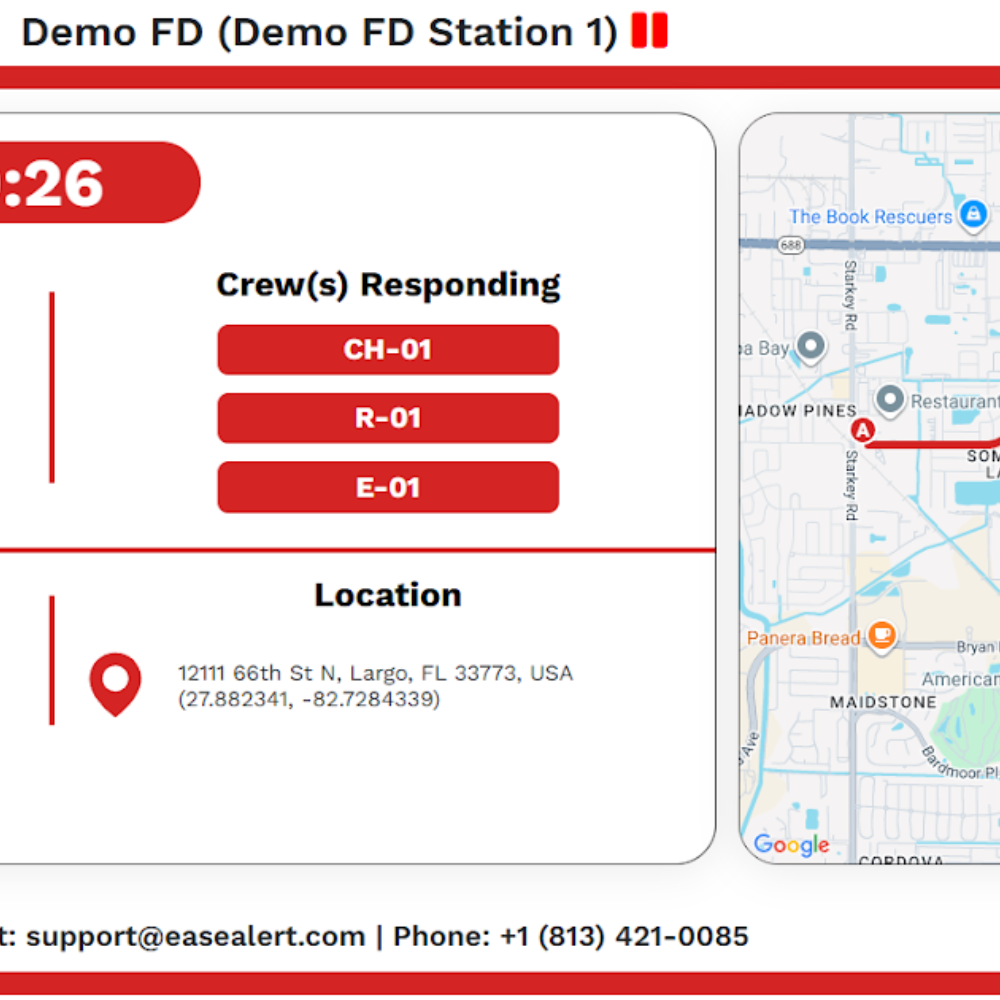
What the system does. A tactile pre-alert reaches the responder who’s due, through a wrist-worn TacPod™ or a BunkAlert™ at the bed, ahead of the station alert rather than in place of it. The station still gets everything it needs: the EA Display Board on your station TVs, Automated Voice Dispatch, a Turnout Timer, SafeTone™ ramped tones and VizAlert™ red lighting. The pre-alert method is patented (US 11,109,213 B2, granted 2021).
What we publish. Participants in a Phase I clinical trial funded by the National Institutes of Health through the NHLBI SBIR program rated the perceived health impact 66.7 against 24.8, a 169% improvement, self-reported, n=34. The study, the sample size and the limits are all on this page.
What nobody in this category can claim yet. That any alerting system prevents cardiac events, guarantees better sleep, or produces an identical result for every firefighter. No published research supports those statements, from us or from anyone else. A vendor who makes one should be asked for the paper.
EaseAlert has changed my career. It makes the transition from down time to emergency response immensely easier on all of our bodies and minds. And it allows me to wear ear plugs at night, drowning out the excess noise, and greatly increasing my sleep when I can get it. All while ensuring I won’t miss a call.
Firefighter Zach Huffman
St. Augustine Fire Department
Audible alerting is not the enemy here, and nothing in the evidence says every station should go silent. The question worth asking is narrower: does everyone in the building need to receive every alert at full volume, or only the people responding to it? EaseAlert® is built to do both.
Full device specifications are on the EaseAlert products page, and the capabilities page covers how the system is deployed in a station.


See EaseAlert in your station
Free station assessment · No obligation
- Wireless install retrofits easily into existing stations and fits cleanly into new builds
- Alert the whole station, a zone, or the one crew that's going
- Integrates with your existing CAD and dispatch processes, so you don't have to change workflows
- Trusted by fire departments nationwide
Free assessment · Nationwide install and support
The bottom line
The risk window around alarm response is real and well documented. The claim that the tone itself is the cause is an inference the published research does not yet support.
That leaves a narrower argument that happens to be more durable: sleep disruption is widespread and badly underdiagnosed in the fire service, waking uninvolved crews has a cost and no benefit, and both of those are things a department can act on without waiting for a trial that has not been run. If a vendor offers you more certainty than that, ask them for the paper. We’ve put ours on this page.
Frequently asked questions
Do fire station alarm tones cause heart attacks?
The published research does not establish that. What it establishes is that firefighters face roughly 14 times the risk of death from heart disease during alarm response compared with routine duties (Kales et al., NEJM, 2007). That window includes the tone, but also near-maximal exertion, an adrenaline surge, heavy gear and driving. No study has isolated the tone.
How many firefighters have a sleep disorder?
37.2% screened positive for at least one in a study of 6,933 firefighters across 66 US departments, including 28.4% for obstructive sleep apnea (Barger et al., Journal of Clinical Sleep Medicine, 2015). More than 80% of those who screened positive were undiagnosed and untreated.
Does tactile or gentler alerting reduce cardiac risk?
Gentler alerting has been shown to reduce the heart rate response. Wistrom and colleagues (2016) found that adding roughly four seconds of volume ramp-up significantly reduced tachycardic responses, with median heart rate increases falling from 7 bpm to 5 bpm. Whether that translates into fewer cardiac events is a different question, and no large trial has tested it.
Is audible alerting unsafe?
No, and that is not what the evidence suggests. Audible alerting is reliable and it works. The narrower question worth asking is whether everyone in the building needs to receive every alert at full volume, or only the crew responding. EaseAlert® does both: full station alerting through displays, voice dispatch, ramped tones and red lighting, plus a tactile pre-alert for the responder on the call.
Does a quieter alert slow down turnout time?
That is the right question to ask and it should be measured rather than assumed, in either direction. NFPA 1710 sets 80 seconds for fire calls and 60 seconds for EMS. Any alerting change should be evaluated against timestamped turnout data from your own department.
Which fire station alerting system has published research behind it?
EaseAlert®. Its tactile pre-alert was tested in a Phase I clinical trial funded by the National Institutes of Health through the NHLBI SBIR program, run with Central Jackson County Fire Protection District in Missouri and Stillwater Fire Department in Oklahoma. Participants rated the perceived health impact of tactile alerting 66.7 out of 100 against 24.8 for their traditional system, self-reported, n=34. We could not find another vendor in this category publishing a trial of its own alerting.
Can EaseAlert alert the whole station?
Yes. The station side is fully covered: the EA Display Board pushes the call to your station TVs, Automated Voice Dispatch reads it out, the Turnout Timer counts up from dispatch, SafeTone™ ramps the audible tone and VizAlert™ ramps red lighting from dim to bright. What EaseAlert® adds on top is a tactile pre-alert that reaches the responder assigned to the call first, through a TacPod™ or a BunkAlert™. You get both layers, and you use the one the call calls for.
Why do vendor health statistics vary so much?
Because most are published without a citation. We could not find a competitor in this category attaching an author, year and link to a health claim. When a number has no source attached, the useful response is to ask for one before you weigh it.
Related reading
References
Kales, S. N., Soteriades, E. S., Christophi, C. A., & Christiani, D. C. (2007). Emergency duties and deaths from heart disease among firefighters in the United States. New England Journal of Medicine, 356(12), 1207-1215. nejm.org
Barger, L. K., Rajaratnam, S. M. W., Wang, W., O’Brien, C. S., Sullivan, J. P., Qadri, S., Lockley, S. W., & Czeisler, C. A. (2015). Common sleep disorders increase risk of motor vehicle crashes and adverse health outcomes in firefighters. Journal of Clinical Sleep Medicine, 11(3), 233-240. pubmed.ncbi.nlm.nih.gov
Marciniak, R. A., Tesch, C. J., & Ebersole, K. T. (2021). Heart rate response to alarm tones in firefighters. International Archives of Occupational and Environmental Health, 94, 783-789. link.springer.com
Wistrom, C. L., et al. (2016). Effect of station-specific alerting and ramp-up tones on firefighters alarm time heart rates. American Industrial Hygiene Association. publications.aiha.org
National Fire Protection Association. Firefighter fatalities in the United States. nfpa.org
International Association of Fire Fighters. Summary sheet: NFPA 1710 standard. iaff.org
NFPA. NFPA 1225, Standard for Emergency Services Communications. nfpa.org
EaseAlert. (2026). The science behind EaseAlert. easealert.com
Every claim on this page carries an author, a year and a link, and every EaseAlert figure carries its sample size and its limits. If you find something here you cannot verify from the source, tell us and we will correct it.
More from the EaseAlert Blog